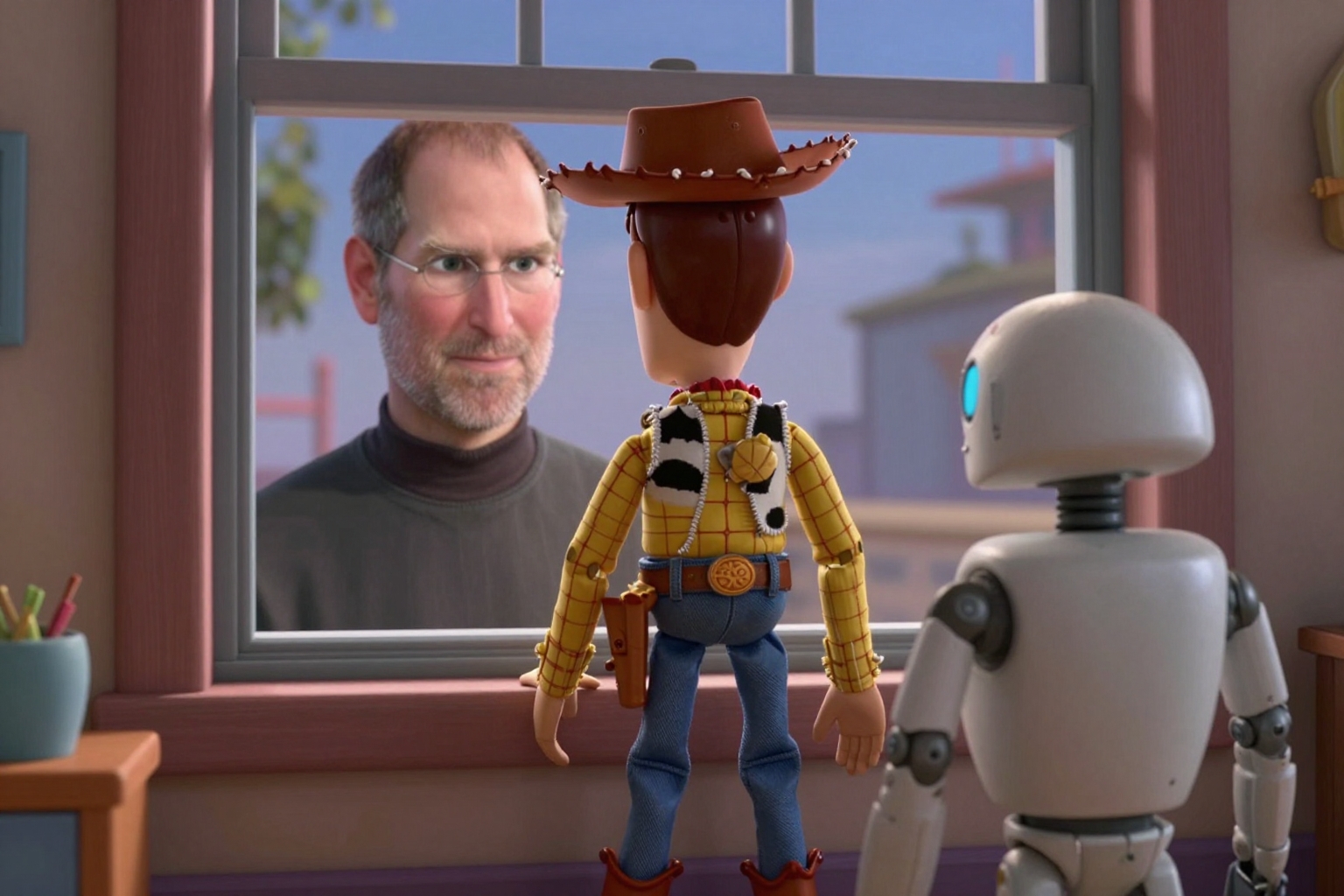
In 1995, I was ten years out of university and raising a young family, with a three-year-old and a one-year-old. As a technologist, I was already a Steve Jobs fan, although I was more interested in what he was doing at NeXT and Pixar than in Apple itself. Then Toy Story arrived, at just the right moment in my life.
It brought together two parts of my world: my interest in technology and my life as a father. A company I followed for its technical ambition was making something I could share with my children. I still recall getting caught up in the frenzy to find a talking Buzz Lightyear toy during the holidays that followed. That gives Toy Story a personal significance for me that goes beyond its place in movie history.
Looking back, it is easy to forget how uncertain that history once was. Released in November 1995, Toy Story was the first entirely computer-animated feature film. [1] Today, as we debate AI actors and filmmaking, I keep coming back to what made those digital toys matter to us: the recognizable feelings and human imagination behind them.
Steve Jobs was central to that gamble. In 1986, he purchased Lucasfilm’s computer division and established Pixar as an independent company. The team’s animation ambitions developed alongside its technology business, eventually leading to a feature-film agreement with Disney in 1991. Jobs supplied the business leadership behind a creative and technical team attempting something no studio had accomplished. [1][2]
Yet the crisis that nearly derailed Toy Story involved a surprisingly familiar Hollywood problem: an unlikable leading man.
On November 19, 1993, Pixar presented Disney with a disastrous story reel. Efforts to make Woody edgy had turned him abrasive and cynical. Hiring froze, and the filmmakers scrambled to revise the material. In the San Francisco Chronicle’s oral history, crew members recalled restoring their own storytelling instincts and rebuilding key scenes around character. The episode became known as “Black Friday.” The film’s future depended on making audiences care about its cowboy. [3]
To me, that is the heart of authenticity in storytelling. Woody’s jealousy, his fear of being replaced, and his eventual friendship with Buzz feel familiar. We can recognize ourselves in a character who has never physically existed. The filmmakers gave those feelings a convincing expression through an unfamiliar medium.
Computers created Toy Story’s images, but artists built and animated its characters, and Tom Hanks and Tim Allen supplied the central voices. Animators studied footage of their recording sessions to shape the performances. The potential disruption was already apparent: WIRED reported in 1995 that Jobs envisioned computer animation potentially supplanting traditional two-dimensional cel animation. [4] Creative possibility and disruption could arrive together.
That history makes me reluctant to dismiss a film simply because its creators use AI. A filmmaker can bring personal experience, taste, humor, and intention to a project while using software to help realize it. The creative choices still matter: what to show, what to leave out, which performance feels right, and when a scene has earned its emotion. If AI helps someone express a vision that would otherwise remain beyond their reach, I see room for something authentic.
Computer animation and generative AI are different technologies, and an emotionally convincing result does not settle questions about how it was made. In September 2025, SAG-AFTRA objected to the synthetic performer Tilly Norwood, arguing that replacing actors threatened livelihoods and alleging that performers’ work had been used without permission or compensation. [5] Those concerns deserve answers. A film can move an audience while its production practices still warrant scrutiny.
But I believe we should leave room for artists to demonstrate what they can do with these tools. For me, authenticity means being able to feel a human point of view in the work. That can come through a drawing, a digital character, or an image shaped with AI. The method alone cannot tell us whether someone has something meaningful to say.
I think back to the young father searching for a talking Buzz Lightyear. The technological breakthrough had become a character I wanted to bring home to my children. If people can use AI to create that kind of connection, could we be looking at the beginnings of another Toy Story?